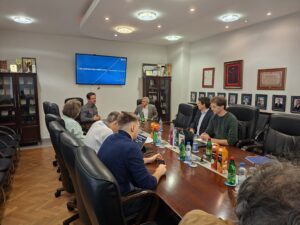
How does Europe enhance research and technological development in space? How does a scientific idea evolve into a real experiment in orbit?
These and many other questions were explored at a seminar dedicated to the work of the European Space Agency (ESA), hosted by the Mihajlo Pupin Institute.
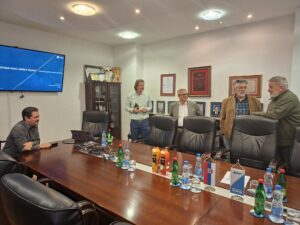
The seminar was also an opportunity to welcome Luciano Catani, Science Attaché at the Embassy of Italy in Belgrade, as part of the initiative to strengthen cooperation and foster connections between Italian and Serbian researchers.
The lecture was delivered by Dr. Matteo Tacconi from the European Space Agency, who provided an overview of the latest developments in space technology. Today, ESA brings together 23 member states and achieves remarkable results across a wide range of areas — from space and planetary exploration, climate monitoring, and Earth observation, to supporting companies engaged in the space sector.
Through programs such as Copernicus and Galileo, ESA develops cutting-edge systems for navigation, communication, and Earth surveillance, while missions like JUICE, Solar Orbiter, and the Webb Space Telescope open new chapters in space discovery.
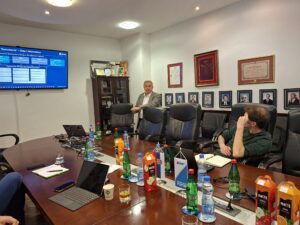
The second part of the seminar offered insights into practical questions researchers often ask — “How does an idea become an experiment launched into space?”
The process involves meticulous planning, systems engineering, and strict ESA and NASA safety standards. Participants were introduced to the V-model of system development, interface management between experiments and space stations, project lifecycle selection, and the adaptation of commercial components for use in space conditions.
“Seminars like this highlight the importance of collaboration between science and engineering, as well as the role of precision, safety, and innovation at every stage – from concept to launch. We were glad to host colleagues from other institutions, including the Astronomical Observatory of Belgrade, with whom we collaborate on the ‘Mosaic’ project.
The Mihajlo Pupin Institute will continue to support knowledge exchange and strengthen connections between Serbian and European experts in the field of space technologies,” said Željko Stojković, Industrial Cooperation Director.